Livestreaming a Sicilian Wedding: How to Include Guests Who Cannot Travel
24 November 2026 · 9 min read · Rosario Spadaro
Yes, you can livestream a Sicilian wedding, and for one specific job it works well: a single fixed camera on the ceremony, for relatives who cannot make the journey. What it will not do is stand in for a photographer, and it rarely works as an all-day broadcast. Before you choose a platform or a camera, decide who is watching and which twenty minutes they must see, then ask the venue and, if you are marrying in a church, the parish what they permit.
Decide what the stream is for before you choose anything
Two different requests hide inside the same question. One is a grandmother who cannot face the flight and wants to see the vows as they happen. The other is a wider group of friends who would like to watch the party from another continent. The first is a ceremony job and can be done well with modest equipment. The second is a broadcast of a long, hot, spread-out day, and it is much harder to arrange without the day starting to bend around it.
Say out loud who the stream is for. If the answer is one or two people, you can be simple and unambitious: one fixed view of the ceremony, sound as good as you can reasonably make it, and a recording sent afterwards to anyone who missed it. If the answer is everyone you know, you are planning a production, and productions need a person whose only job that day is the production.
There is a quieter cost as well. Guests who know a camera is running behave slightly differently. Not badly, but they check themselves, they wave, they wait for the lens before walking down the aisle. A small camera at the back, clearly nobody's focus, is forgotten within a minute. A large one in the middle of the room is not.
If most of your guests are flying in and only a few will be watching from home, it helps to separate the two groups early. There is a guide on this site to planning one Palermo wedding for local family and guests who fly in, which covers the evening before and the two-language problem; a stream is simply the third, smallest audience.
The ceremony is the part worth streaming
A Sicilian wedding day is long. It usually moves between more than one place, the meal runs for hours, and by the time the dancing starts almost everything is happening in low light. Streaming all of that is technically possible and rarely worth the effort or the intrusion.
The ceremony is different. It has a beginning, an end, everyone in one place and a clear thing happening at the front. It is also the part that the people who cannot travel most want to see, and the part where a fixed camera is least in the way.
Everything after it is better recorded than broadcast. If the speeches matter to someone at home, ask a guest to make a simple recording from their seat: imperfect sound, right moment, no live camera running through dinner. The couple who wanted to watch the vows are usually satisfied by the vows.
Where the camera can stand, and what that costs the photographs
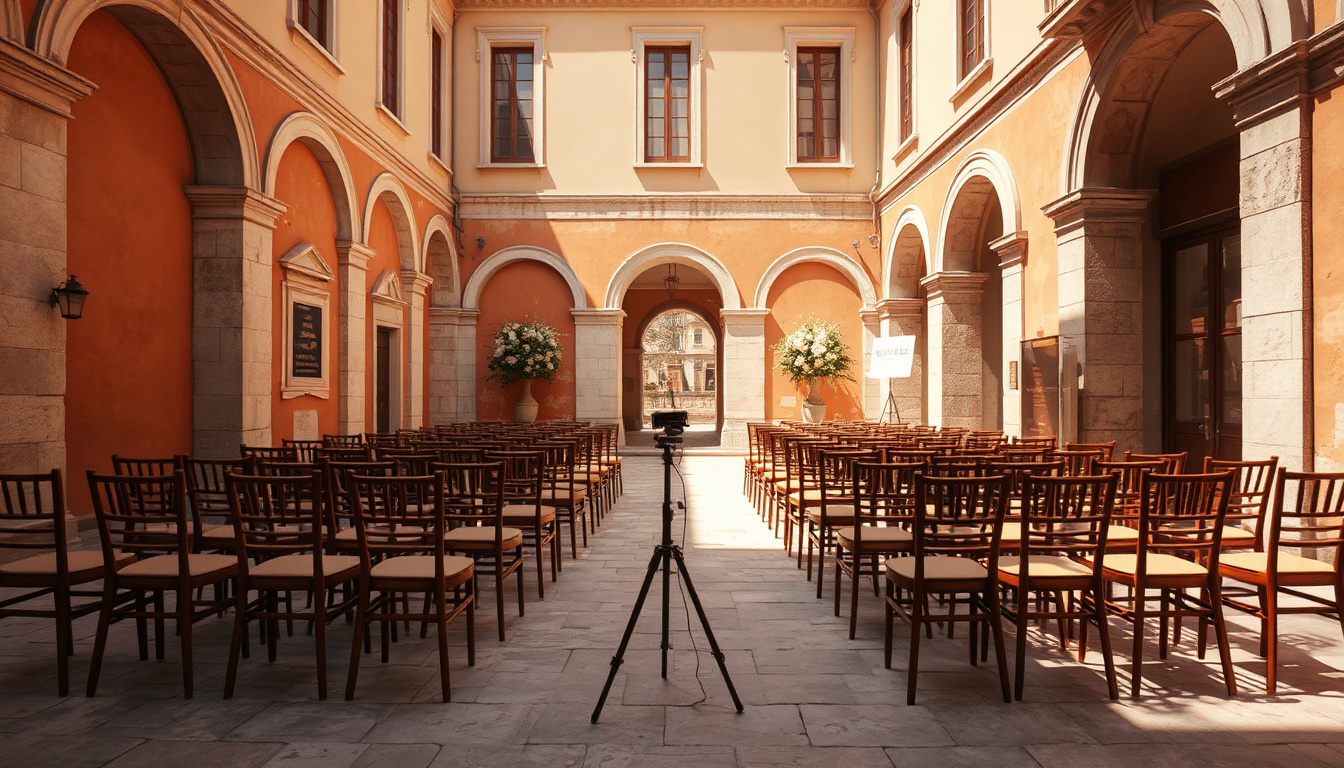
The instinct is to put the camera where it can see best, which is normally the centre of the aisle. Don't. The aisle is a working space. It is where you walk, where the photographs of that walk are made, and where every guest turns to look. A tripod standing in it changes the shape of the ceremony, and it appears in every wide frame afterwards.
The reliable position is at the back of the seating, slightly off the central line, at roughly seated head height, with a clear view of the two of you. In a courtyard with columns or a church with a long nave, walk that line yourself before the day and check that the heads in the fourth row do not sit exactly where your faces will be. The same logic that governs how the chairs are arranged governs the camera: find the sightline first, then place everything else around it.
Ask whether the equipment can go in before the first guests are seated and be left running, with one person checking it once. An unattended fixed camera is nearly invisible. An operator stepping between rows during the vows is not, and no photograph will recover that.
Churches, cloisters and historic interiors usually have their own conditions about cameras, tripods and where equipment may stand, and those conditions are set by the parish, the foundation or the Comune rather than by the reception venue. Ask early, in writing, and expect a specific answer. There is a fuller guide to permissions in Sicily for the ceremonies and sites that need authorising.
Sound is the part that usually fails
Picture is easy now. Sound is not. Vows are said quietly, in a stone room, over a fountain, a fan, a breeze moving through a courtyard, or two hundred people settling into their chairs.
Ask three questions of the venue or the celebrant. Does the celebrant use a microphone and amplification? Can the stream take a feed from that microphone, or can a small recorder sit beside the speaker? And is there a quiet place to put a second microphone near where the two of you will stand?
A stream with perfect picture and inaudible vows has failed at the only thing it was asked to do. If you cannot solve the sound properly, solve it differently: record the ceremony audio separately on a phone placed close to a speaker, and marry that recording to the video afterwards. If your ceremony runs in two languages, that clean audio matters more, not less, because the people at home need to hear both halves of it.
Who actually runs it, and what each option asks of you
There are four realistic arrangements, and each one trades something away.
Whichever you choose, name the person on the ground. A stream that depends on the couple checking a screen is a stream that will not be checked.
- A guest with a phone on a small tripod. Cheapest, and adequate for a short ceremony if the guest is seated at the back and has been asked well in advance. The cost is that this person spends your wedding day working rather than being present.
- A fixed camera streaming unattended. Least intrusive and least visible in your photographs. It depends entirely on a connection that holds and on one person nominated to start it and check it.
- A videographer for the ceremony only. The best sound and picture by a wide margin. Ask the venue whether external suppliers are permitted for the ceremony and what access they are given.
- Asking your photographer. Ask directly and expect an honest answer. Photographing a wedding and running a live broadcast are two different jobs, and I would rather do one of them well than both badly. If a couple wants a stream, my preference is to help them place a fixed camera where it will not trouble the ceremony, check it once, and then go back to photographing the day.
Time zones, the link and the people watching
Sicily is on Central European Time, which means your ceremony hour lands at a very different point in the day for guests in North America, Australia or east Asia. Give them a watching time converted for them, with the date, rather than the ceremony hour as it appears on your invitation. A guest who sets an alarm for the wrong morning does not watch twice.
Keep it simple and keep it private. One link, sent once, in one place: a private group or a single email rather than three reminders across four channels. Nominate one relative to manage comments, or switch them off entirely so nothing has to be moderated during your ceremony.
Tell watching guests what to expect. That the stream will begin a few minutes before you walk in, that it will end after you leave, and that it may wobble. And tell the guests in the room, once, on the information page or through the celebrant at the start. A stream is not an exception to asking people to keep their phones down in the aisle; if anything it is the reason to ask, since a livestream is best watched by people who are not in the room. There is a separate article on asking guests to put their phones away if you want the wording.
An illustrative arrangement for a Palermo courtyard ceremony
What follows is illustrative rather than a template: a late-afternoon ceremony in a Palermo courtyard, with relatives in Britain and the United States unable to travel. Your own version depends on the space, the celebrant and who is willing to hold the job.
- Before you book. Ask the venue whether a small camera on a tripod is permitted in the ceremony space, who authorises it, and whether the celebrant uses amplification. Ask in writing and keep the reply.
- The day before. Have the person running the stream visit the courtyard at the hour of the ceremony, stand where the camera will stand, and check the view, the signal and the account in that exact spot.
- Before the first guests are seated. The camera goes in, at the back and off the central line, and stays untouched for the rest of the ceremony.
- During the ceremony. Nobody adjusts anything. One person watches a muted screen from the back row and does nothing else.
- At the exit. The stream stops once you have walked out. The rest of the day is photographed and, if the speeches matter, recorded by a guest for sending on.
What to send the venue and the church before you book
Put these in the first email rather than the last. The answers change which arrangement you choose, and some of them take longer to come back than you expect.
Get the answers in writing, and test the arrangement in the real space rather than a nearby one. Courtyards, thick stone walls and below-ground rooms behave very differently from the terrace where the signal looks excellent.
If you are still working out how the ceremony itself will run — where the chairs go, who stands where, whether a camera at the back helps or intrudes — tell me your date, the part of Sicily you are considering and what matters most to the people who cannot travel. You can check your date here, and I will answer personally, in English or Italian.
- Is a fixed camera on a tripod allowed in the ceremony space, and who authorises it?
- Can equipment be placed before guests arrive, and when must it be removed?
- Does the celebrant use a microphone, and can we take a feed from it or place a recorder beside the speaker?
- Where in the space does a signal actually work, and is there a landline or venue network we can use?
- If the ceremony is in a church, what does the parish require of cameras and of anyone operating one?
- Are external suppliers permitted, if we decide on a videographer for the ceremony alone?
- Who from the venue is on site that day, and who do we contact if the stream drops mid-ceremony?
Frequently asked
- Can we livestream a church wedding in Sicily?
- The parish decides, not the reception venue, so ask the church directly and early. Expect conditions about where a camera may stand, whether a tripod is allowed and whether the church's own sound system can be used. Get the answer in writing before you plan anything around it.
- Will our photographer run the livestream for us?
- Ask directly rather than assuming. Photographing a wedding day and running a live broadcast are separate jobs, and a documentary photographer is usually moving through the day rather than guarding a screen. Many couples are better served by a fixed camera and one nominated guest.
- Should we stream the whole wedding day?
- Usually not. The ceremony has a fixed shape and everyone in one place; the reception is long, moves between spaces and happens largely in low light. Record the speeches on a phone from a seat and send the file afterwards instead.
- What happens if the connection fails during the ceremony?
- Ask the venue where a signal reliably works, keep a phone with a data plan as a backup, and record locally as well as streaming so nothing is lost if the broadcast drops. Test it in the exact spot at the hour of the ceremony, not from the car park.
- Do we have to tell guests they are being filmed?
- Yes, and it is usually a relief. One line on the guest information page, plus a word from the celebrant at the start, is enough. Guests relax when they know what is happening, and anyone who would rather not appear can be given a quiet exception.
Sources & further reading
Photographed across the whole island
See how a Sicilian wedding day is documented on the Destination Wedding Sicily home page, explore the location guides, or view the full Italian portfolio at rosariospadaro.com.
Check your dateKeep reading