Planning a Palermo Wedding for Local Family and Guests Who Fly In
18 November 2026 · 8 min read · Rosario Spadaro
Almost every Palermo wedding I photograph has two audiences in the same room. One side lives twenty minutes away and knows exactly how hot the afternoon will be. The other has just landed, is faintly jet-lagged and is not entirely sure what happens after the ceremony. The day works when you plan for both from the outset: an arrival time that protects the travellers, an evening that lets the two groups meet, and an end of the night that leaves nobody stranded.
Start with two lists, not one guest list
Before you look at a floor plan, split the guest list in two and write four things beside every name: where they are sleeping, how they will reach the ceremony, whether they will still be there at midnight, and what they will do the following morning. The answers are usually very different for the two halves of the room, and they shape more of the day than the menu does.
Guests who live in Palermo know the heat, know the coast road on a Saturday and will drive themselves home when the dancing thins out. Guests who have flown in from London, New York, Munich or Sydney need something else: a hotel they can find at midnight, a coach they do not have to negotiate in a language they may not speak, and a clear idea of what to wear to a church or a garden in September.
None of this means planning two weddings. It means noticing early which parts of the day are doing the work for each group. The briefing you send guests before a Palermo wedding carries the information itself; this is about the shape of the day around it.
The ceremony hour is rarely yours to choose
In Palermo the hour usually comes from somewhere else. A civil ceremony follows the Comune and the space it uses. A church ceremony follows the parish timetable. A symbolic ceremony can be moved, but then it has to sit sensibly against dinner and the light. Couples planning from abroad are often surprised by how little there is to negotiate.
What you do control is the hour before. Publish an arrival time as well as a ceremony time, and make it earlier than feels necessary: twenty or thirty minutes for a ceremony with no transfers, considerably more if guests are being moved by coach from a hotel. If the invitation gives only the ceremony hour, the travellers will arrive precisely on time and slightly panicked, and the locals will arrive late because they know how the city runs.
That arrival window is also the part of the day I watch most closely. It is when the two halves of the guest list meet, when the church or the garden fills, and when people who have not seen each other for years work out where to stand.
Give the two groups one evening to become one room
The most useful thing you can do for a mixed guest list is to hold something the night before. A welcome dinner, even a short one, does what the wedding day itself has no room to do: it lets your Sicilian relatives meet your friends from abroad while everyone is dressed casually and nobody has been photographed yet.
Two conditions make it work. Keep it close to where the travellers are sleeping, so nobody has to solve a cross-city journey on their first evening in the country. And keep it short: drinks and one course, an hour and a half at most. Hold the speeches back for the wedding day, when everyone has slept.
The trade-off is real. A second event costs money, takes planning energy and asks something of guests who landed that afternoon. With a small guest list that is already close, it may be unnecessary. When one family has never met the other, it is usually the best money spent that weekend. Choosing a welcome dinner venue in Palermo covers the settings and the transfer question in detail.
Seating, speeches and the two-language problem
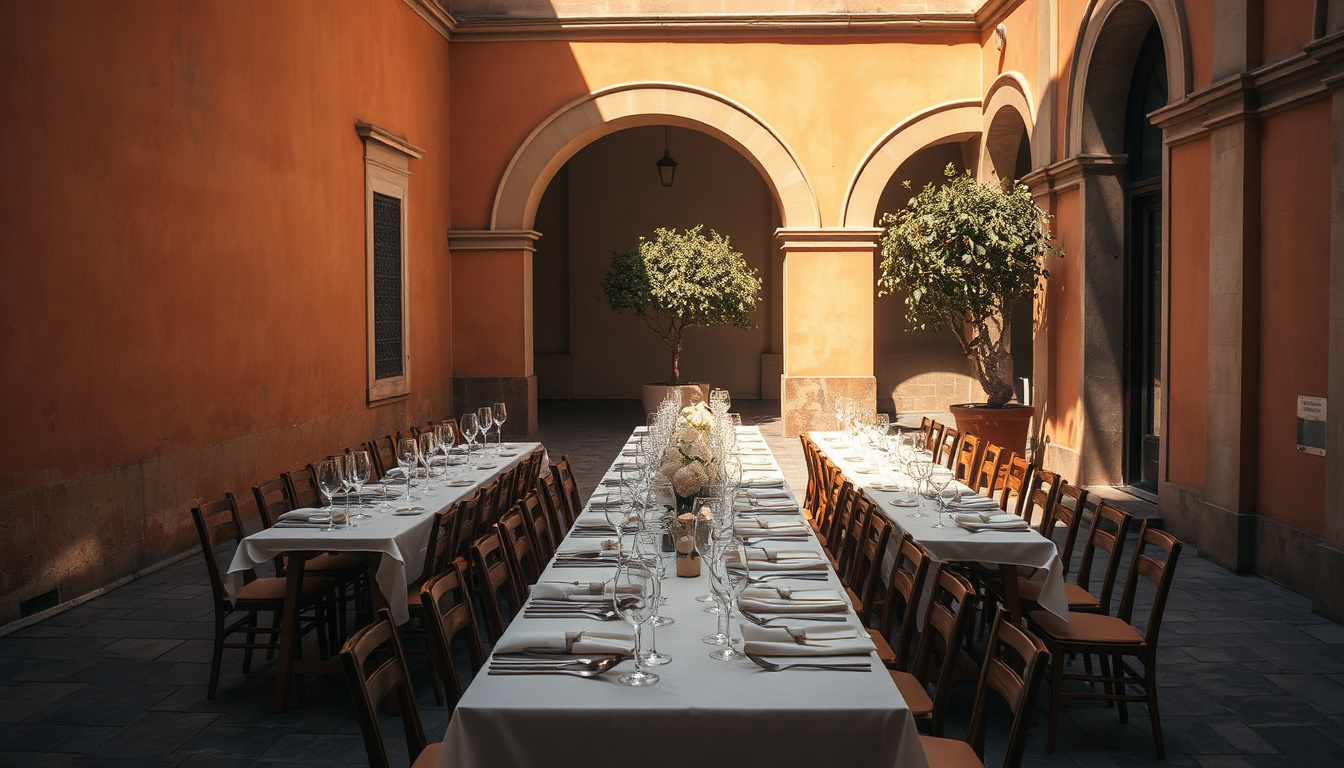
Long tables tend to separate your audiences. They fill from one end, and the travellers end up together at the far end, which is comfortable but defeats the purpose. If you want a room that mixes, tables of eight to ten, each with at least two guests who know the area, work better than one long line.
Speeches are where the language question becomes concrete. You do not need a bilingual wedding; you need the three or four moments that carry meaning to be understood by everyone present. In practice that means a short summary after each speech rather than a translation during it, a printed order of the day in both languages, and one person asked in advance to do the work rather than a volunteer found on the night.
Ask anyone speaking to keep it under five minutes and to send you the outline beforehand. Not to edit it, but because a speech written for one audience reads differently in a room where half the guests are waiting for a translation.
An illustrative shape to the day
This is a shape rather than a timetable, and it depends entirely on your date, your ceremony type and how far the reception sits from the ceremony. Read it as a way of thinking about the two audiences, not a schedule to copy.
- Mid-morning. Travelling guests are at breakfast, working out the day. One printed page in the welcome bag does more than a group chat.
- Late morning. Local family arrive at the house where you are getting ready, already dressed, already useful. This is often the first hour in which the two families overlap.
- The ceremony. Arrival window published twenty to thirty minutes ahead. Guests who drove park nearby; guests on the coach arrive together, which is calmer than it sounds.
- The gap. Aperitivo at the reception venue, or a return to the hotel. The travellers need somewhere to sit; the locals need to know when to come back.
- Dinner. Speeches early, before the room tires. Tables deliberately mixed rather than grouped by origin.
- Late evening. The local half begins to leave; the travelling half is still dancing. Plan the transport for the second group, not the first.
The end of the night is where the two audiences divide
By midnight the room has usually sorted itself. Guests who live nearby slip away quietly and the floor is left to the people with nowhere to be the next morning. That is not a failing party; it is what a Palermo wedding with a mixed list normally looks like.
What matters is that the travellers are not left working out a taxi in a city they do not know. Agree a return time with your transport provider, tell guests what it is, and decide in advance what happens to anyone who wants to stay later than the coach does. Getting around Palermo on a wedding day explains why the map misleads you here, and why the last hour usually decides the plan.
What this does to the photographs
A mixed guest list is a gift for documentary photographs, though not for the reasons couples expect. The frames that matter are rarely the posed groups. They are the moment a Sicilian aunt decides the visitors from Manchester need a second helping, the ten minutes when the church is half full and people are greeting each other in two languages, and the last hour, when the travelling guests have finally stopped being polite.
Practically, it changes where I stand. Arrivals matter more, so I am near the door rather than at the altar. Tables matter more, because the mixing happens there in the first twenty minutes of dinner. The end of the night matters more, because that is when the two groups are properly at ease with one another.
If you want to see how a city day behaves across the seasons, the Palermo destination guide sets out the months that work, how guests arrive and where ceremonies are held. The portfolio shows frames chosen for one reason only: something real happened.
What to ask before you book, from another country
Send these in your first enquiry and ask for written answers rather than a call:
One habit saves a great deal of confusion: keep a single document with every answer, dated, and share it with your planner and your transport provider. Most of the friction at a Palermo wedding with international guests comes from a detail agreed in one email and remembered differently by three people.
If you are planning a Palermo wedding with guests on both sides of the journey, tell me the date, the venue if you already have one, and roughly how the guest list splits. That is usually enough for me to say something useful about how the day will run and what it will look like.
Check your date and tell me what matters most to you.
- Can the venue hold both the ceremony and the dinner, or will guests move between two places?
- What time can we have access, and what time must we be out?
- Where can a coach stop, and how far is the walk from there to the ceremony space?
- Is there a curfew, and on what terms could it be extended?
- Can a welcome dinner be held here the evening before, and is the space exclusive to us?
- Who is the point of contact on the day for transfers and timings?
Frequently asked
- Should everyone be invited to the welcome dinner?
- Not necessarily. The useful version is open to anyone who has travelled, plus the relatives they have not yet met. Cousins who live twenty minutes away may prefer to arrive on the wedding day itself, and that is fine. Keep the evening short and near the travellers' hotel.
- How do we word invitations when half the guests live in Palermo?
- One invitation should serve both. Give the arrival time, the address and a mobile number, and say plainly whether transport is provided and from where. Local guests need less information, but they still need to know when to arrive rather than when the ceremony starts.
- Do we need to arrange transport for guests who live nearby?
- Rarely for the ceremony, often for the end of the night. If the reception sits outside the city with limited parking, a shuttle from a central point serves locals and travellers equally. Ask the venue where vehicles can actually stop before promising anyone a door-to-door service.
- What if only one of us has family in Sicily?
- The mix is smaller but the principle holds. Seat visiting guests with the relatives who will look after them, hold one informal evening before the wedding, and ask one person on each side to keep an eye on the other's guests during the day.
- Does a mixed guest list change how much photography we need?
- It usually argues for earlier coverage, beginning with the arrivals and the getting-ready hours, rather than a longer evening. The greetings, the first meetings and the half-full church are the frames you cannot recreate later.
Sources & further reading
Photographed across the whole island
See how a Sicilian wedding day is documented on the Destination Wedding Sicily home page, explore the location guides, or view the full Italian portfolio at rosariospadaro.com.
Check your dateKeep reading