How to Arrange Ceremony Seating at a Palermo Wedding So Guests Can See
21 November 2026 · 8 min read · Rosario Spadaro
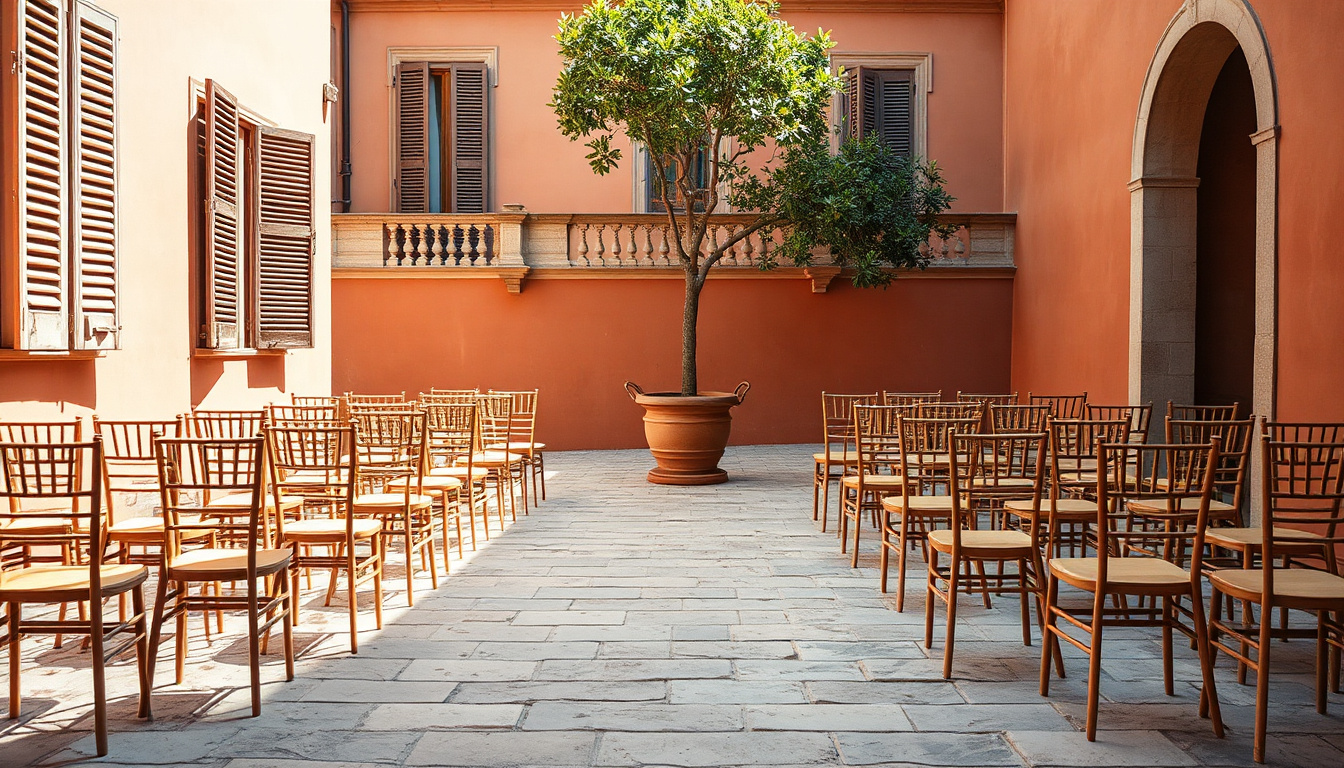
The arrangement that works most often in Palermo is simple: a clear central aisle, chairs set in rows angled slightly towards the centre rather than a tight grid, and the ceremony turned so you are lit from the side or the front, never facing into the sun. Guests need to see your faces. What you cannot change — fixed pews, the shape of a courtyard, a licensed capacity — is worth discovering before you draw anything.
Find out what the space fixes, and what you decide
In a church, the pews are fixed and the parish decides what happens around them. In a Comune ceremony room, the room itself usually sets the layout. In a private venue — a garden, a courtyard, a terrace — you may have genuine freedom, but somebody still has to supply the chairs, place them and clear them afterwards.
Four things are worth establishing before you sketch anything: who sets the layout, who supplies the seating, what time you are allowed into the space that morning, and whether another event shares the day. Those answers decide whether the arrangement is yours to design or simply yours to walk through.
If the venue is not settled yet, start with choosing a Palermo venue, which explains how the ceremony type narrows the list, and the Palermo destination guide for how the city and the coast around it behave on a wedding day. Once the venue is fixed, seating is one of the few parts of the ceremony you can genuinely plan from another country.
Rows, a curve or loose chairs: the trade-offs
Straight rows fit the most people into a small space and photograph tidily. Their weakness is the back row: on flat ground, with everyone seated at the same height, the fourth row often sees the celebrant and very little of your faces.
A gently curved arrangement — two blocks angled towards the centre — costs a little space and buys noticeably better sightlines. It also gives the space a shape in the wide photographs, rather than the look of a conference room.
Loose chairs, or standing, suit a short symbolic ceremony for twenty people and can feel relaxed and warm. It is worth being honest about your guest list here: standing for half an hour in the heat is easy for some and hard for others. A mixed arrangement, with a few rows at the front and standing space behind, is often the practical compromise.
The aisle is a working space, not only a walk
The aisle carries three things at once: you, whoever walks with you, and the moment the room turns to look. Ask what the surface is before you choose your shoes — stone flags, gravel, grass and old cobbles all behave differently, and all of them are harder in the middle of a hot afternoon than they look in a photograph of an empty courtyard.
Width matters more than length. The aisle needs to take two people walking side by side, a parent with a small child, and anyone using a wheelchair or a stick. That is not a figure on a plan; it is something to test with the venue's own chairs, set out the way they will be on the day.
Two further things settle here. First, where I can stand: at the side, near the front, without crossing the aisle or blocking a guest's view. Second, where the exit and the greeting line happen — whether you walk out into an open courtyard or turn straight into a wall and a parked car changes the end of the ceremony in photographs and in memory.
Where the sun will be at your ceremony hour
A ceremony at ten in the morning and one at six in the evening ask for opposite arrangements in the same courtyard. What you want is light arriving from the side or slightly in front of you, so faces are lit and nobody is squinting. What you want to avoid is standing with the sun directly behind you, which turns you into two silhouettes against a very bright background.
The reliable way to judge this from abroad is to ask for a viewing, or a photograph, at your own ceremony hour rather than at whatever hour suits the venue. If you can travel, planning a visit to Palermo venues explains how to use that trip well. If you cannot, ask someone to photograph the space at your hour on a date close to yours — the light moves through the year, and a picture taken in April is not a picture of September.
Look, too, at what sits behind the ceremony: a stone wall, a hedge, an open view, a doorway. That background appears in almost every wide frame of your vows, and it is much easier to accept before the day than to overlook afterwards.
Sightlines: what the fourth row can actually see
Flat ground is the enemy. If the courtyard or garden has a step, a terrace or a slope, use it. Otherwise, stagger the chairs by half a place so each guest sits in the gap in front of them, which costs nothing and helps more than it sounds.
Walk the space from the back row, sitting down, before you agree anything. Columns, potted plants, a fountain, a low wall, the celebrant's table — anything standing between the last row and your faces is worth moving now, while it is still a drawing rather than a guest's disappointment.
Then think about who sits where. Older relatives often appreciate the front, and the front row is also the row in every photograph, so it is worth putting people there whom you genuinely want in those frames. Tall guests at the ends of rows, small children near their parents, and a little standing space at the back for anyone who needs to move quietly are small decisions that make the half hour easier for everyone.
An illustrative arrangement for a courtyard ceremony
What follows is an illustration, not a template. Your own version depends on the space, the hour, the number of guests and what the venue allows.
A church ceremony runs to a different logic, because the parish controls the building rather than the venue; pairing a church ceremony with a Palermo reception covers what that changes for the rest of the day.
- Two blocks of chairs, angled slightly towards the centre, with a clear aisle between them wide enough for two people abreast.
- You and the celebrant at the far end, turned a little towards the light rather than straight into it, with the best available background behind you and not behind your guests.
- Readers and whoever holds the rings to one side, close enough to step forward without walking the length of the aisle.
- The back row in shade if there is any, with a gap at the rear so late arrivals can slip in without a performance.
- A short, deliberate pause at the head of the aisle before the entrance begins.
What the layout changes in the photographs
More than any decoration does. The arrangement decides whether I can photograph your faces during the vows or only your backs, whether the wide frames hold your guests or a blank wall, and how close I can work without becoming part of the ceremony myself.
It also decides the shape of the entrance. A long aisle under trees, a short crossing of stone flags, a doorway you appear in — each gives that moment a different rhythm and asks for a different place to stand. None of it needs staging or direction. It needs to be settled before the chairs go out.
What to send the venue before the layout is fixed
A short email, sent early, saves a great deal of guesswork later. Ask:
Answers in writing are worth more than answers on a call, particularly when a detail will be passed between the venue, a caterer and a planner who may not meet each other until the week itself.
If you are weighing up a layout and want a second opinion on how it will photograph, send me your date, the venue and roughly how many guests you expect through the contact page — I am glad to look at the arrangement with you before anything is fixed.
- Who supplies the chairs, who sets them out, and who clears them at the end?
- What time can we get into the space on the morning, and when must it be returned to normal?
- Is any part of the layout fixed — fixed seating, the celebrant's position, a licensed capacity for seated guests?
- Can we see the space, or a photograph of it, at our ceremony hour on a date close to ours?
- Where does the shade fall at that hour, and what is the ground surface?
- Where can vehicles stop, and how far do guests walk from there?
- Is another event using the same space that day?
Frequently asked
- Does the venue supply the chairs, or do we hire them separately?
- It varies, and it is worth getting the answer in writing rather than assuming. Ask who supplies the seating, how many chairs are included, who sets them out and who clears them at the end. On a day when the space is used twice, the answer sometimes changes between the two events.
- Can we arrange the chairs in a curve or a circle instead of rows?
- Often yes, in a private venue with room to spare. A curve improves sightlines noticeably and gives the space a shape in photographs. A full circle suits a small symbolic ceremony but leaves half the guests looking at other people's shoulders, and it is harder to photograph without walking into the middle of the ceremony. Ask the venue what the space allows.
- How wide should the aisle be?
- Wide enough for two people walking together, and for a wheelchair, a walking stick or a parent with a child. Rather than working to a number, ask the venue to set out a few chairs as they will be on the day and walk it yourself — or have someone film it for you if you are still abroad.
- What if we are marrying in a church with fixed pews?
- Then the parish decides the layout and there is little to arrange. What you can still settle is who sits where, where the readings happen and where photography is permitted during the ceremony. The parish office is the authority on all three, and it is worth asking before you build a plan around them.
Sources & further reading
Photographed across the whole island
See how a Sicilian wedding day is documented on the Destination Wedding Sicily home page, explore the location guides, or view the full Italian portfolio at rosariospadaro.com.
Check your dateKeep reading