Getting Around Palermo on Your Wedding Day: Transfers, Drop-offs and the End of the Night
26 October 2026 · 8 min read · Rosario Spadaro
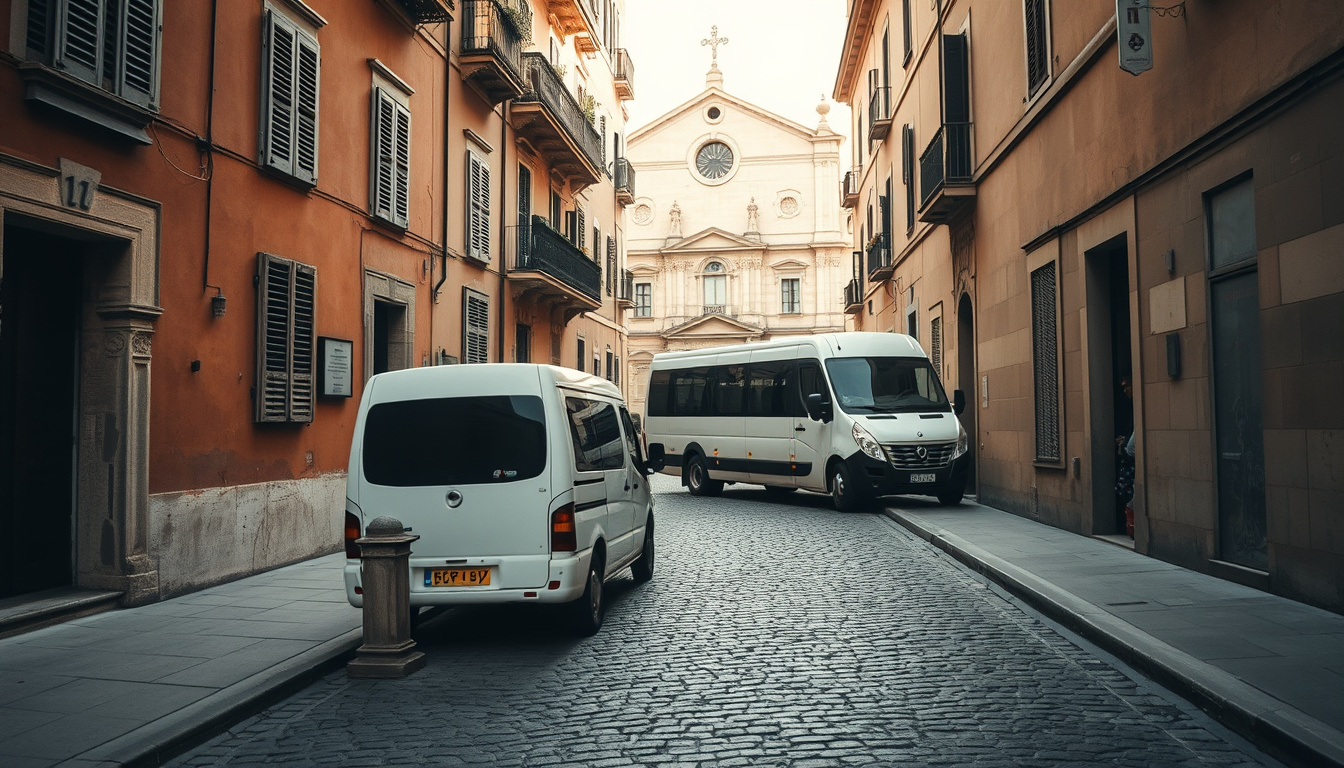
The useful answer first: in Palermo, the transport plan and the venue choice are the same decision. Days run calmly when the party moves once — one ceremony place, one reception place, one agreed drop-off for each — and when the venue has confirmed in writing where vehicles may stop and who controls access. What follows is how I would work that out before you commit to a building, written from how the day moves rather than from a map.
Why the map misleads you in Palermo
Palermo is a city where two addresses a few streets apart can take twenty minutes, and two addresses on opposite sides of the centre can take twelve. The historic core is dense, much of it one-way, and the restricted traffic zone limits who may drive in and when. My Palermo destination guide says it plainly: traffic is significant, and transfers between a venue and a church need generous margins.
So do not plan the day in kilometres. Plan it in moves: how many times the same group of people has to get into a vehicle, and what happens to the rest of the schedule when one of those moves slips by half an hour.
A calm Palermo wedding day usually makes three moves or fewer. A rushed one usually makes five. The difference is rarely distance; it is the number of times you ask the same group to be somewhere at a given minute, in heat, in formal clothes, with a coach driver who does not know the streets.
There is a second consequence. A place that looks convenient on a map is only convenient if a vehicle can stop near the door at the hour you need it. In the centre that is a question for the venue and, where public streets are involved, for the Comune — not something to infer from a street view on a screen.
The moves a Palermo wedding day tends to make
Treat the following as an illustration, not a schedule to copy. A winter wedding inside the centre, a summer wedding between the centre and the coast, and a wedding held entirely within one venue will each reshape it.
Read that list and count the vehicles. If your draft plan needs a coach, a bridal car and three separate taxis at different hours, the plan is probably too complicated for a day that also has to hold a ceremony, a dinner and a party.
- The morning. Both parties get ready within the same part of the city, so the first transfer of the day is the shortest one. If you are preparing in two different places, the drive between them is often the most fragile half hour of the whole day.
- Guests move to the ceremony. A coach or minibus leaves one base together. Anyone driving themselves needs a drop-off that does not depend on finding parking in the centre, which in practice it will not.
- The ceremony ends and the portrait window opens. This is where a day either breathes or collapses. The photographs taken in the twenty minutes after the ceremony happen while guests are still finding each other, and the vehicle is either waiting or already gone.
- The move to the reception. Guests arrive first; you arrive after them. The last few minutes of that journey are part of the day, not dead time — they are often the quietest frames of the afternoon.
- The end of the night. A fixed departure time for the return transfer, agreed in advance, with one named person responsible for it.
The split day: a ceremony in the centre, a reception outside it
The most common Palermo shape is a ceremony in the historic centre and a reception outside it — in Mondello, along the coast, or at a villa inland. It gives you the city in the morning and the sea or a garden in the evening. It also asks every guest to get into a vehicle twice. Here is the honest comparison.
If I had to choose one shape for a couple planning from abroad, I would keep the ceremony and the reception close together and let the city be the setting rather than an extra stop. One location used well photographs better than three used quickly.
- Everything in one place. Guests are dropped once or park once. Nothing is lost to traffic, and the photographs lean on the venue's own light: a courtyard, a terrace, a garden, a long table under trees. The trade-off is that the day has one setting, and if that setting is harsh at your ceremony hour, you cannot step out of it.
- Ceremony in the centre, reception outside. You get baroque streets, a change of light across the day, and the drive between the two often produces the most alive photographs of the wedding. You pay for it in time: a second transfer, guests arriving before the reception is ready for them, and older relatives doing the same walk twice.
- Two locations plus a portrait stop on the way. This looks efficient on paper and usually is not. Your car detours, your guests arrive early, and the portrait window you saved is spent in a car park behind a venue.
What vehicles can actually do near the centre
Coach size, street width, permission to enter the restricted zone and the willingness of a driver to wait are all decided locally, and they differ from one street to the next. Ask rather than assume, and get the answer in writing. If you are planning a viewing trip, the questions below are the ones worth carrying with you — there is more on using that trip well in visiting Palermo wedding venues.
The other half of the question is on foot. Cobbles, shallow steps, a stretch of open square at one in the afternoon: these decide how the last two hundred metres feel for a grandparent in the heat far more than the drive does.
Questions to send the venue before the plan is fixed
- Where exactly may a coach or minibus stop at the ceremony and at the reception, and for how long?
- Is that street inside the restricted traffic zone, and does the venue arrange permits for wedding vehicles and suppliers?
- How far is the walk from the drop-off to the door, over what surface, and how much of it is in shade at our ceremony hour?
- What have recent weddings here done about the move between ceremony and reception?
- Who at the venue do our drivers speak to on the day, and what is their number?
- By what time does the venue need guests to have left at the end of the night?
The end of the night decides the plan
Couples spend months on the arrival and almost no time on the departure, and the departure is where a well-organised day comes apart. If your guests are spread between the centre, Mondello and a hotel near the airport, one coach cannot serve all three at one in the morning.
Two arrangements usually work: everyone sleeps in one base, or the return runs in two waves with a stated departure time for each and someone standing by the door to call it. The wider question of which base to recommend is worth settling before you publish a save-the-date — I have written about that separately in where your guests should stay for a Palermo wedding.
Also settle what happens to the people who want to stay until the last song. A fixed final transfer with a named time is kinder than a bus idling outside while thirty guests negotiate.
What the movement does to your photographs
A slipped transfer does not merely delay dinner. It eats the portrait window, and that window is the only part of the day where light and time can be shaped at all. The location work I would plan for a Palermo wedding — covered in where to take wedding photographs in Palermo — assumes a realistic amount of time between two fixed points. Cut the time and the honest response is fewer places, not faster photographs.
The walk from the vehicle to the door is often where the day's best frames are: concentration on faces, a last adjustment of a jacket, the moment before the doors open. If the plan keeps that walk short and shaded rather than eliminating it, you gain rather than lose.
Two things I would protect in any Palermo schedule: a real buffer before the ceremony, so nobody arrives flustered, and one stretch of the day where nobody is on a timetable at all. Both are cheaper to arrange in advance than to recover on the day.
Arranging all of this from another country
Someone has to own the movement plan, and from abroad that person is usually your planner or the venue's coordinator. Ask for it in writing: drop-off points, times, who is called if a vehicle is late, and how the return works. One page is enough.
Send that page to the drivers, share it with your photographer, and keep a copy with you on the day. Then go through it again in the final weeks, because roadworks, a closed square and a summer evening do not appear in the plan you made in January. If a detail cannot be confirmed in writing, treat it as unconfirmed rather than as agreed.
If you are weighing up Palermo venues and want to know how each one would change the shape of your day, tell me the date you are considering, the locations on your shortlist and roughly how many guests are travelling. Those three answers usually settle the rest — you can check your date here.
Frequently asked
- Do we need to organise transport for our guests in Palermo?
- Not always, but decide it early. If the ceremony and reception are in two places, or your guests are spread between the centre and the coast, a coach or minibus removes the most common source of delay. If everything happens in one venue with parking, guests can arrange themselves. Ask the venue what recent weddings have done.
- How long should we allow between the ceremony and the reception?
- There is no correct number, and anyone who gives you one without knowing your venues is guessing. What matters is what your guests do while you are being photographed: a drinks reception they can walk straight into is worth more than a scenic detour. In July and August, add time rather than subtract it.
- Can a coach stop outside a church or palazzo in the centre?
- Sometimes, briefly, and often not exactly where you would choose. Stopping points in the historic centre are set by the Comune and by the venue's own arrangements. Ask for the permitted point in writing, pass it to the driver, and work out the walking route from there. Do not rely on the driver finding a space on the day.
- What about older guests and anyone who cannot walk far?
- Plan the shortest drop-off, over the smoothest surface, in shade where possible, and put it in writing. Cobbles, steps and early afternoon heat affect mobility more than distance does. If the gap between the vehicle and the door is long, a smaller vehicle is usually easier to arrange than a change of venue.
- When should we take the couple photographs?
- Before or after both work, but decide it against the light and the movement rather than leaving it open. Before the ceremony you are working in a calmer, cooler city; after it, you are working with the energy of the day and a fixed dinner time. The mistake is letting it happen in the ten minutes when everyone is being moved to the reception.
Sources & further reading
Photographed across the whole island
See how a Sicilian wedding day is documented on the Destination Wedding Sicily home page, explore the location guides, or view the full Italian portfolio at rosariospadaro.com.
Check your dateKeep reading